In the Bushman Folklore, the Mantis has a place of significance. On the one hand he is regarded as a deity, creator of all things; on the other he is also human. He manifests himself in many forms and appears to be a character full of contradictions
1 Introduction
This movement is a kind of overture: Mantis is represented by two motifs: a slow undulating melodic phrase and a brief rhythmic figure.

2 A Dream Dreaming Us
The Mantis appears at the beginning of the world when he is carried over the dark waters by the bee. The bee becomes so weary in his search for solid ground that eventually he and the Mantis have tp float on the water. It is then that the bee discovers a big white flower. He lays the Mantis in the heart of the half-open flower and plants within him the seed of the first Bushman.
3 The First Fire
Originally the Ostrich kept fire hidden under his wings. Observing this, the wily Mantis hatched a plan to bring the fire to mankind. He led the Ostrich to a tree full of fruit. In his greed to reach the juiciest ones higher in the tree, the Ostrich had to stand on tip-toe and flap his wings. At that moment he dropped the fire.
4 Death and Honey
Mantis as protector, fetches honey to feed the Eland. Realising the uniqueness of the nectar, Meerkat kills the Eland to steal the honey for his own protection. When Mantis discovers this, he is so angry that he shoots the Meerkat with arrows. But it is too late.......
5 Metamorphosis
Mantis plays a trick on the children by transforming himself into a dead Hartebeest. The children skin it and cut off its head which they take home with them. On the way, the Mantis comes to life, giving the children a terrible fright.
6 The Son of Mantis
Mantis sends his son out to look for sticks to make arrows. The son asks the Baboons to help him but, while they are doing so, they realise that they are the intented targets of the arrows. They kill him and gauge out his eye.
Mantis, searching for his missing son, comes upon the Baboons playing ball with the eye. Realising that it is his son's, Mantis, after a scrimage snatches the eye (ball), dives into the water and regenerates his son from it.
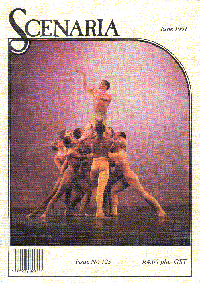 Imaginative. This is the keyword in describing Cape Town composer Hans Roosenschoon's ballet Mantis. The music is delightful in its changing moods, the orchestration is brilliant.......